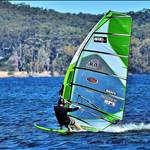
Another day, and another day without wind so had to resort to playing with the Fangy Fin again. It really should be in the running for gift of the year as this thing just keeps on giving. I'd be hard pressed to decide between a ball, some cardboard and hot glue or a Fangy fin for long term entertainment. My kids are getting bigger so its a Fangy fin for me now....I have a Netflix account too but I don't think I've used it in months thanks to this thing. Was really not gonna post anything until made some decent progress....however..some of you are obviously very bored from lack of wind...
Today: Started resanding the FF24, (anodised once) with the idea to do a light sand and anodise again to replicate the success of my first FF22 attempt. Failed, the porosity was really bad, way way worse than the native fin and I really lost motivation....why spend all this time sanding only to get a result that is way worse than when you started. Whilst sanding was thinking of how to go about actually making a supersonic cold spray device when it occurred to me haven't tried something basic. Hopefully others have tried and will stop me before doing this if its not a good idea. (I already know its a good idea and nobody has tried but putting it out there)
I'd had enough of all this sanding and porosity after just 5 fins (no clue how fangman has done 300+ of these things) so ordered some nice fresh billet to cut a nice fin from scratch. Fangman and I had made some progress speaking digitally enough that we could communicate between ourselves and to the outside world. I managed to convince someone to agree to bring Fangman's love child into the real world using a CNC and eliminate 99% of all this sanding/trying to get a surface finish BS/time wasting. No doubt there will be some other issues arising but they will be trivial compared to this current saga.
Simultaneously to all that, I thought bead blasting the cast fins to seal/close/hide the porosity prior to anodising might be a good plan. I'd spent 10 years in previous life perfecting this process so probably should give it a try before abandoning the cast. Motivated again, I aimed to have three fins ready for bead blasting tomorrow as the CNC machine is just a few yards from my bead blaster of choice. First fin,the new Skunk works Fangman special cast FF18V4, exactly the same as the CNC one so can compare the orange to apple but at least exactly the same same size. Have finished it to a rushed maybe 400 Grit, 2nd fin, a FF24 anodised with low desmut, resanded (looks like ****) at 1200 then 800 and then lost interest, FF28 (just looks like ****..but you would too if you went through what it went through). Me thinks bead blast will bash surface of all three so you won't be able to tell them apart.
To close the day off, I'd read that brake cleaning fluid gets rid of silicates and silicon so I got myself some and applied it to the freshly sanded skunkworks cast FF18V4. Not one sign of black goo coming out. Like zero...of anything. So chucked fin in a warm (50degC) bath of soapy water and hit it with ultrasonics. I'd calibrated this thing to a tank of methylated spirits so maybe the power xfer was a bit out with water. I fiddled around with position of fin in bath and it made a massive difference to acoustic power applied. From almost zero to overload. I measured the current from battery and got a max of 2.5amps at around 13.X volts when fin was in optimal position. Assuming electronics are around 90% efficient that's about 30W good vibrations into the bath. (the electronics limit the power to 36W best case for a 40W transducer so 30W is probably a reasonable max)....regardless still did bugger all as far as getting that black goo out.
Not many bubbles compared to methylated spirits and didn't want to leave in tank so pulled it out but was surprised to see 'blast marks' coming out of the porosity adjacent to where the ultrasonic transducer was. These are in the metal and can't be rubbed off. Damm, more sanding.
In the same photo you can see the porosity...its never ending with one almost bullet hole size, I hit this thing with 80 grit flapper disc till it now bears no resemblance to Fangmans original intended shape and the effort was completely pointless. (oddly the opposite side has almost no porosity which seems to be the case in all fins I've played with, note to self: is porosity only on one side? and same side for all fins)
Tomorrows mission, get the CNC loaded and bead blast the hell out of 3 various buggered up Fangy fins to see if it makes the slightest difference. Luckily I can find the almen intensity if needed but thinking this process will either do nothing or large improvement.
From memory we always did an almen intensity of 7 but can't remember if it was A or C. (It might sound impressive but the Almen is how much a piece of metal of thickness A= 0.051" or C=0.094" deflects when you blast one side with whatever you've got. The more intensity (faster or heavier) the more the material deflects due to cold working just one side. Its vaguely similar to anodising in that it hardens surface but in this application I am hoping it will clean out/mash the porosity into surrounding material to give a uniform surface to anodise. If this fails can still try shot peening or sandblasting...showing how much joy just a single Fangy fin can bring.



 I'll do a before and after pic...