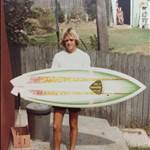
Picking up a 6'4 tomorrow for the bigger stuff,hope the swell spike hangs in for another day,although it only jumped from 1-2ft to 3-4ft but great shape.heres the piece Nick wrote on the Campbell bros Bonzers.
Surfline's
Nick Carroll replies: WK sticks to its long-held theory that no surfboard has drawbacks. They all, however, have their very own performance characteristics, which may or may not suit the prevailing styles of surfing and approaches to waves. The Bonzer is without doubt surfing's greatest example of a surfboard design slipping through the cracks, so to speak. When it was first created back in 1970 in Ventura by brothers team Malcolm and Duncan Campbell, it was a decade or two ahead of its time -- basically a single-to-double concave with three fins. Several top professional surfers, notably Ian Cairns, Peter Townend and Terry Richardson, rode Bonzers with great success, but the design didn't catch on, partly because it was difficult to imitate; not too many shapers were interested in concaves in the early 1970s, and the keel-style side fins didn't come off the shelf. It may also have been that shortboard style -- at the time only a few years beyond longboards -- wasn't ready for a board that drove turns past its natural arc, as Bonzers and Thrusters both tend to do. It took the pressure of big time pro surfing in small surf through the late 1970s to take surfing styles to those levels. Twin-fins -- originally another 1970 idea -- came along again in 1976, then the Thruster in 1980, then the single-to-double concaves in 1989. These design shifts largely did for performance what Bonzers might have done years before, but in a simpler, easier-to-imitate fashion. Meanwhile Duncan and Malcolm refined the Bonzer idea, coming up with double keel side-fin setups and moderating the dramatic concave nozzles. Quite a few top surfers rode it, especially in the mid to late 1990s, and loved its drivey certainty. The Bonzer feel is essentially that of an enhanced single-fin, very sure of itself in the pocket and on the rail, and very tail-based. But the truth is that at the high-tech cutting edge of modern performance surfing, surfers have advanced well beyond an enhanced single-fin approach, and no longer ride solely in a tail-based fashion. They're riding off rail concaves, front rail edges, rockers ... just about any surface available, and they need a freer tail than that supplied by the Bonzer design. This does NOT rule out the Bonzer as a great design for the power surfer who's looking to carve strong rail turns and ride the tube. For such surfers, it's an excellent alternative to standard Thruster design, and WK encourages its use.

Submit your surfboard design question at
[email protected]

 I am pretty sure a few folks would love to see and hear a bit more about it!
 but seriously.