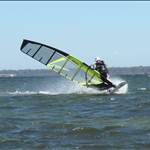
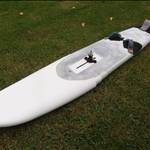
Not every idea is a winner. I decided to make a 'foil on a strut' and explore the possibilty of increased efficiency by reducing drag and putting the foil in a cleaner flow. A FF24 was sacrificed and the design roughly cut out with an angle grinder. A quick layer of etch primer to I could photograph the curves more clearly and then it was time for a splash.
The fin worked well when loaded. It went uphill very happily and displayed no real vices. However, downhill it didn't feel any more slippery than a FF24 and ventilated badly at speed when confronted by thick weed. Even worse, it is possibly the worst fin I have made when gybing. It simply feels like some one has thrown out a bucket tied to the back of the board once the fin is no longer heavily loaded. The drag is depressingly real.
So atthe end of part one of this experiment, my conclusion is; at this point in time, keep your angle grinders cool as there is nothing to be gained by doing this.


I had fallen down the rabbit hole of the Theory of Lift. I had thought science had a handle on this one. It turns out that there is no academic consensus on why planes don't fall out of the air. Bernoulli's Laws apply well to laminar flow in a tube, but don't translate well to free stream flows and provide no explanation of stall behaviour. Newtons laws provide explanation for the final result, but some researchers feel they fall a little short on the explanation of separation from the upper wing. ( I am not sure I support this view just yet ) Fractal vortex flow may fill in the gaps, but at this point in time appears to be a nice idea, but has no hard research to back it up.
I don't feel as though I the tiniest fraction of creativity of Lewis Carrol, but decided to chuck all my ideas and thought bubbles down the same rabbit hole. I didn't have an Alice in Wonderland moment at the end, rather just another weird looking chunk of aluminium masquerading as a heavy weed fin.
This fin is typified by its massive cutout, and scalloped chord shape along the base. The premise of the design is that the junction of the board and fin occurs at, or very close to, a free surface. The flow here is very turbulent due to the large pressure interferences and I suspect, incapable of producing meaningful lift in comparison to the drag from the surface area of the fin along the chord width. Therefore, I aimed to reduce the energy loss from turbulence and surface area drag at the junction and move the active foil area into a cleaner water flow.
The end result is a 'strut' joining the fillet base to the foil. The inherent strength of the aluminium is critical in allowing substantial reduction in the foil base in both width and depth. This design may not be possible to replicate with traditional fin making materials. The strut is intended to be as slippery as possible and not contribute greatly to the lift of the fin. Its outline is closer to the NACA supercritical symmetrical foil shapes.
The foil proper is a standard FF. The trailing edge thickness is slightly greater and only slightly rounded in an effort to keep trailing edge vortices small in area and limit interaction with foil surface vortices. A secondary effect of the forward 'strut' placement was to try to induce a little twisting as the physical properties of aluminium seem to lend themselves to this behaviour.
Although it has become clear that my grasp of hydrodynamics is limited at best, I haven't given up entirely, I am going to muck around with the foil and the strut foil junction some more, but I have a feeling I may be trying to put lipstick on a pig. Another Top Ten Fangy Fail...



 . The 24 is on the water, and good to hear all went well.


 I like the idea of gap filla.