WING MASTS FOR THE HOME BUILDER.
Please be aware this is a method from which a large number of wing masts of various profiles, sections and sizes have been built. I am not intending to make the design decisions for the builder, just give a very successful method which has stood the test of time, and the rigors of Landyachts. By the way, this is not my sole “intellectual property” A number of people have been involved in this evolution.
Landyachts have immensely stable platforms, the loads which are applied to the rig are huge, and the apparent windloads are readily in excess of 60 miles per hour. The method seems almost too simple, and many people have said that the wings will not last, believe me they have stood capsize onto hard ground at 30 miles per hour plus, compressive loads which will part 6mm 1 x 19 stainless wire and still keep going a number of years later.
The hardest part is making the decisions over section and proportion of total rig. I have generally gone for an area of about 15% of the total sail area, and section is usually a NACA symmetrical one, with a fore and aft dimension of about 12 inches, and a thickness of up to 4 inches. Another way is to consider the foil of the whole sail plan which you would like to achieve, decide on the wing chord, then plot the curve of that, then make this a symmetrical section (assuming you are making a “two way” rig) Strangely after having done this a number of times on paper, it usually matches a symmetrical NACA section, don't know why though! My choice has always been by guess, others have spent many hours plotting L/D curves, the results on the beach are very hard to tell apart. Isn't theory wonderful?
Now, how to do it.
Material of choice is “blue” polystyrene foam, commonly used in this country on the outside of houses. It is cheap and accessable.
You also need a piece of clear straight timber the length of the mast, make this up earlier, scarf, or one piece, it doesn't matter, also needed is the sail track, I have used both alloy and plastic, proper sail track and caravan (trailer to the North American) awning track. All have worked. Choose one with small flanges, or cut them off Also allow to cut off the thickness of your “trailing edge stringer” from the section drawing. Plot this onto the drawing, to see how it will fit, and transfer to your cutting patterns which I usually photocopy and glue to the hardboard pattern material.
Make patterns of the foil you have chosen, we usually use hardboard, some have done it with alloy sheet, but any hardish material is fine. The patterns should be as smooth and accurate as possible, this avoids the hotwire “snagging” on roughness. The patterns need marking evenly with a numbering system, at intervals of 5 to 10% of the distance around their perimeter, I usually start at the leading edge. Also mark a centre line, and drill a couple of holes through which some 3” nails pass firmly.
As the blocks of foam which we can get are 4 feet long you need to design the wing in multiples of that dimension (easiest anyway). Most of my wings have been parallel section except for the top one or one and a half sections which taper.
Now nail a pattern on one end of the foam block. Using “wind sticks” nail a pattern on the other end of the same block, check for as little twist between the patterns as you can achieve. (The human eye and long wind sticks is the best way we have yet found).
Using a hot wire and foam cutting bow and TWO PEOPLE start cutting into the leading edge, make sure you are both going to go the same way, ie up or down, yes we have gone opposite ways and it makes very strange shapes. When you are JUST touching the pattern begin calling the previously marked numbers so that you keep as close to each other as you can, Call out, 0, 5, 10 etc but try to keep moving. The one who is ahead should slow down, rather than rush the slower cut.-when you reach the trailing edge cut away. Now repeat going the other way round the same piece. KEEP the offcuts, they make very useful bits to rest it all in.
When you have cut all your pieces, take a break, the most nerve wracking bit is done. Now glue all your bits together,(glue can be anything which will glue foam it needs no strength as the foam would only break away from the glue anyway) BE ACCURATE, do not keep the patterns attached. If you think about it you may have had to only make a total of 3 patterns, as you just move onto the next block, if the tip is only one piece long.
You should now have a great big long piece of foam which you are now going to glue to the trailing edge stringer. Again check for twist and bend. By now you will have realized that you need a bench at least the length of the mast, although I have made them on the floor (of the hallway in the house). Again just use a basic glue, hot glue, Gorilla glue, 5 Minute epoxy etc.
This should have taken a reasonable evening so far, so either stand back and admire, or carry on!
The next step is to cut the whole thing in half! Through the major thickness. Has been done with saws but the hot wire is easier except where you hit the glue lines. This is a cut from side to side, running from top to bottom .
Now is another choice. I have made this next step, the “web” from 3mm ply, or tri-axial fiberglass. I have no preference.
If using glass, round off the edges of the trailing piece of foam to allow an easy lay of the glass. (Usual radius rules apply). Now lay the glass tape, make a good weight lay up, 16oz plus and epoxy to the foam. Easiest way is with the mast on the trailing edge stringer, CHECK STRAIGHT AND TWIST AGAIN. Wet out the foam, apply the tape, squeegee etc, make sure the tape wraps round your curved edge nicely etc .Use good quality epoxy
If you choose to use ply, glue the ply into one long web (usual scarf joints) then glue onto the foam in a similar method to above .Use good quality epoxy
NOW let it all go off hard, ie LEAVE IT ALONE!
If you used a ply web, use this as a guide for the router, cut a groove into the trailing edge foam, against the ply, into which you are now going to glue a 12mm (1/2 inch) alloy solid bar on each side of the mast. Let this go hard. Use good epoxy, and follow instructions re gluing alloy.
Glue the leading edge back on
Cut away the foam as far back as the web for an area about 6 inches either side of the hounds fitting. Make up a wooden block (cedar etc) to take up this space. While you are playing with wood, make a base from wood, I think this should be about 3 inches thick, either end grain or a more solid timber and the complete profile of the mast, and a tip which can be about 1 inch thick.. How you deal with halyard etc is your call, halyard locks are my preference.
You now need to attach the track to the trailing edge, glue works fine. Fair the whole trailing edge, leaving some means of keying it all together. At the same time fair in the hounds, base, and tip. Epoxy filler is fine. If you wish now carry on to the next step, you do not need for this filler to cure.
The next bit is the most time consuming. This is the covering which is load bearing. Depending on the length of the mast, sail area etc the glass layup will vary. For a 20 foot long I have used as little as 2 layers of 6 oz woven cloth with another 2layers around the hounds fitting. Usual thoughts of spreading the size of patches apply. I have also used a bit more sophisticated lay ups, S glass etc, and also run a tove of carbon down the web from top to bottom. All have survived so I am undecided on what is needed, probably less than we think, but probably a bit more material is not going to weigh much, the cost is minimal, and the unit will live longer. I have always done this with the whole thing standing on the trailing edge, the glass going past the track for later trimming. Brace the wing, so that it does not fall over, is straight and not twisted (yet again)
This time you really do need to stand back, breath a sigh of relief, have a coffee, etc.
Let the whole deal cure, then fill and fair till you are happy. Fasten a hounds fitting (which will need to be custom made) experience tells us these are single point attachment standing off the leading edge. Fit a mast support on the base. Again a cup fitting seems best, usually directly under the major width of the mast. Too far back, and the mast will oscillate which can get rather exciting, too far forward and it will over rotate VERY easily.-
How long does all this take? Masts have been made in 2 evenings, and sailed less than 36 hours later, but this is pressing too much. Easily done in a week of evenings, if everything is to hand.
Do they work? Much better than a standard mast, is it worth it? If you are building a multihull, you are already stretching the performance envelope, take the next step!
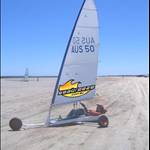
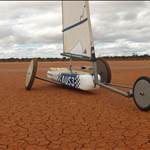
What should sails be like? Most sailmakers do not have a clue on how to make sails for wings! All the successful sails for wings which I have seen (and there have been a number) are PANEL FLAT, with a touch of luff round, (less than 1%) about 33% up from the foot. If there is panel shape you will get a sail foil, trying to blend into a mast foil. What I call a “double bump” and it is slow.(Have seen lots of these too!)
















 [}:)]
[}:)]