Well, if age is what matters, does that mean that you prefer One Direction to the Rolling Stones, Sex Pistols, Nirvana or whoever?

Most sports gear is old. The Tour de France or Olympic track bikes are restricted to a basic design that dates back to around 1895. The rowing eights are restricted to a design of similar age. It's like in golf - there are rules that prevent anyone from designing a golf ball that goes further, so that everyone from the club hacker to Tiger can use the same gear and feel the same challenge, and no one has to redesign courses as gear changes, etc.
In those sports and almost all others, no one bothers to create new gear that doesn't fit into rules that restrict its performance....they would think that sailors are odd because they see that the challenge lies in the athlete performing better, not in the athlete buying faster gear from a shop.
I'm no Finn sailor, but plenty of very, very smart people who are brilliant sailors say that they offer brilliant tactical racing in a boat that demands a huge amount of tuning knowledge.
I do sail Lasers which are slightly slower, and I find them fantastic. Sure, they are slow, but who cares? If pure speed was all that was fun then who would sail slalom instead of speed kiting, indeed who would sail at all? My family won Bridge to Bridge waterski races in our class and getting dragged flat stick over flat water behind a worked V8 can be boring as batcrap.
As the guy who owned, created and sailed what was until recently the world's fastest small boat says, there seems to be something about the way that medium-speed boats like Finns, Stars, Etchells and Lasers fit into the wind shift, gust and lull structure that makes them particularly challenging for most people in terms of tactics and tuning.
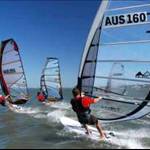
For example, sailing a slalom board would don't have to respond to the waves in the same way as when you are sailing a Laser upwind. At 25+ knots on a slalom board, you are crossing each wave in a fraction of a second and don't have time to react; nor do you have to change the rig in the same way as the apparent wind angles and strength don't change as quickly, and the rig does most of the work automatically.
In contrast, in a Laser you are often going slowly and must react differently, and there is a fascinating and intricate series of moves with every part of the body above the waist for every wave. As you go up the wave you steer up with the tiller and a slight leeward roll and sheet in with the mainsheet and roll your upper body aft. As you reach the crest you roll the upper body forward to push the bow down, ease the mainsheet out, roll to windward, and bear away, all in a second or two; then you start the sequence again. If you get one wave wrong out of the hundreds you will face and lose 1.5 metres, you may lose an entire championship because the racing is incredibly close.
You do that for every wave in a beat a lot of the time, while keeping your head swivelling because the fact that the boat is slow means that your opposition is close, there are lots of them, and the fact that you can tack do quickly means that a 10 second puff brings with it a whole host of questions; do you tack to take this 5 degree lift over to that bunch, do you hold this tack to stay in contact with that bunch while keeping to the right of the next bunch to get the tide, or do you split the difference because the wind is slowly going north and the tide is weakening and Bob is behind you and faster downwind and he's just 2 points behind..... It's not the sort of racing where you can largely concentrate on simply going fast while hitting the laylines.
Because lots of people are going pretty much as fast as the best guys, the racing is very tactical, lots of people can get encouraged and the fleets are huge - 47 at our club alone, and there are over a dozen other fleets just in Sydney. There are 1500 spots in the various divisions at the worlds, and yet sailors under 35 (and even many of the Masters) have to earn a qualifying spot by being in the top 5 or so out of the 100+ in your district, and that can take years of full-time sailing to achieve... it's very different from classes where you just sail once or twice a week and roll up to the 65-competitor worlds.
The boats are slow largely because the boats are designed so that everyone can sail them. And the boats are slow because they are convenient to own; as boats go they are simple to rig, cheap to run, less hassle to own. They are designed to be convenient rather than fast, so you get lots of sailors and lots of good racing.
The Finn has different but similar attractions.
In flat-water windsurfing, many people have been saying for years that it's all about the speed - and that's left the sport deep in a hole now that kites have come along and gone faster.
Oh, and of course for most of any typical day in most places, a Laser or Finn would actually be one hell of a lot quicker than a short board, because the short board is normally on the beach or off the plane because the wind is too light, or struggling to sail in the sort of narrow and fluky places many dinghies sail in. So the board is only quicker some of the time, and then if it's maximum speed that we are talking about, then kiteboards and speed boards rule.
Slalom is great (I did a lot of it at a pretty high level at times) but the other forms of sailing are just as great in different ways. If they weren't, people wouldn't do them.