Te Hau said...petermac33 said...
This conversation is complete double dutch to me.
Not one sentence can i make head nor tail of.
All i know is,if you sheet in,in the gusts,you go faster or you go over the handle bars.
Yep, I reckon some of these boyos may be getting baffled by science.....
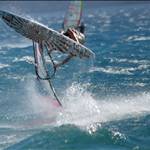
what I know is that my boards get up in the air in the bear offs and hover with the whole lot out of the water.The faster I go the more lift I get off the nose and I build my boards with varying nose areas just to use this effect.
I'm up to speedy #8 now and mostly playing with this effect.
The fastest runs I've done have been hover jobs and I don't feel the chop 'cos the board's not in the water.I call that sail lift and nose lift.
I've also (for other sailors) modified a number of older longer slalom boards for using as speed boards.
They all have the problem of too much nose lift in big gusts and by shortening the nose and reducing the area this problem comes totally under control so I guess that indicates that nose lift is real and it is a sizeable force.
No science, no theory just the real world , chop it up and see.

I'm not getting baffled by the science, I'm a scientist, in a previous life I used to design wind tunnels.
We're just using unfamiliar terminology that makes it seem more complicated than it really is. All you really need to be able to do is visualise pressure. Blow up a ballon a few times and get the hang of pressure.
Then if you can arrange for the pressure of air or water on one side of a solid object to be more than the other you get lift.
But one big constraint on all this is as a particle of fluid, air or water, moves into a region of higher pressure it must slow down. All a particle of fluid, say a 1cm by 1 cm by 1cm cube can see is its neighbours, if the one in front is pushing back with higher pressure than the one behind it'll slow down.
You've probably seen the equation F=ma the harder you push something the quicker it accelerates. This equation is called Newton's second law of motion. It's pretty intuitive, we all know you've got to push heavy things harder to get them up to speed.
The fluid dynamicists modified Newton's equation to allow for the flexible nature of fluids, the force becomes a pressure gradient, friction became viscosity, they still refer to it as the Navier-Stokes equation because that sounds more complex than "F=ma for fluids".
So in specially designed wings the air over the top speeds up a bit and the air below slows down a bit. But you can only speed air up by a small percentage, and slow the air down below by a small percentage, otherwise smooth flow becomes unfeasible. The more wind speed you have to start with the more you can slow the air down without upsetting smooth flow.
That's why the wing loadings for various aircraft are much higher for faster planes, you can afford to drop or raise the pressure further without correspondingly slowing or speeding the airstream up or down by more than a few percent.
The hang glider - wingloading 6.3 kg per square metre goes about 30 knots
Spitfire 158 kg per square metre 300 knots
A380 663 Kg per square metre even faster
So ground effect or not I have trouble seeing any wing of 1 square metre developing much more than 6.3 kg of lift efficiently in 30 knots. In attempting to generate 25 kg the air on the underside would be brought to a stand still or the air on the upper surface coaxed to do more than 50 knots, or a combination of both, unlikely, I can't visualise a flow pattern consistent with this.



 as some skills just carn,t be explained by science.



 )Sometimes two wrongs combine to get the right number... But then look at the area from the mast track back that is sitting at 1 or 2 cm off the water, with a chord of ~1m in the apparent wind direction... The first graph shows that things get funky under 5% of chord. Lift/drag goes thru the roof. I dont think thats just the drag disappearing.


 )
)