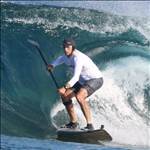
cantSUPenough said..This video goes a long way to answering what I was hoping to learn in this thread - it is about posture on the wave: knees, back, and head position.
Mate great video!
Given my board size I have been focusing a lot on lateral stability. I've been given a number of good tips along the way by Colas as well as personal experimentation which has really helped.
Given my boards range from 7"2 to 7"7 this becomes even more important. I had something of a discovery just recently where I discovered my head position was predominantly in the downwards position. I think this comes from the nature of stand up paddling where you can easily build the bad habit of looking down whether it's your feet or the tip of the board. This became even more noticeable upon take off.
So what I've done by way of conscious attention is to look out instead of down no matter what. This has had a real positive effect. Firstly, as he states in the video, the moment you bend you head down it seems to have a cascading effect of bringing the upper torso in a similarly downward position.
Why does this happen?
Well biomechanically a pronounced forward head posture must affect the rest of the body to compensate. If you notice in the video he emphasises lowering you body by dropping the knees which brings the hips down BUT without breaking at the waist. He also keeps looking OUT so the line under his chin is parallel to his knees in the crouched position.
Now if you fast forward in the video there is a point where he does break at the waist - impossible not to - but his chin is up and he keeps looking out. That's an important key.
Secondly by looking out and not down regardless of paddle position I'm not focusing on maintaining stability through conscious attention but rather let the rest of my body take over in the background. This is working for me. I liken this to learning to drive a car. At first you focus on all the little nuances that make up the driving experience. After a while however, you forget these steps and simply drive - seemingly your hands and feet do it in automatic.
Where this becomes more important is on take-off when the board is angled so there is extra effort to look ahead instead of looking down at the bottom of the wave which creates the sensation of almost falling forward which results a lot of times in the rider overcompensating by tilting back and falling off the back of the board. Clearly balance is the key so head and feet position accompanied by not breaking at the waist dominates this balancing act.
Apologies for the long post. Thread has really promoted self analysis in a good way.
Ozzie

 . I have in fact bought a surfskate (check out the Smoothstar website). I'm only 4 weeks in, but my balance, posture and ability to rotate through a turn has improved so much.