Chook2 said.. You can sail an uncut windsurfer sail that is rigged correctly, in almost twice the wind strength of a similar "conventional/old fashioned" land yacht sail.

We have proved this on many occasions.
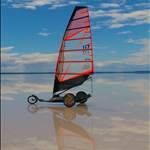
When the blokarts were over powered on 2mtr sails and were quitting sailing due to the extreme wind gusts in Kingston South Australia early this year, I could still easily out run them with much more ground speed, having fun in my mini fitted with a 6.6 mtr sail still averaging in the mid 80's kmh.
Quite a few guys took my mini for a run with this sail in these conditions and couldn't believe how easily it handled the wind gusts. When you sheet out in a gust, the sail is absolutely drum tight, so it's impossible to get it to flap and the top simply weather vanes/twists off till the gust eases.
This mean that only 3 sails 5.5, 6.6 and 8.3mtr cover me from 3 to 40+ knots. (I have other sizes that I'm still testing but only take 3 to events.)
Greg and I haven't reinvented the wheel in Esperance, we have just taken on board all the development the windsurfing community have proven over the last 15 years. They windsurf at 54 plus knots on water, with 6m2 to 7m2 sails, so why shouldn't it work on land.
It's dirt cheap to try these rigs, as the gear is available in good quantities as the windsurfers upgrade each year. All my rigs came from the "recycling centre" at the waste disposal site, (thanks "sn") or given to me as the older model (mine are 2008) sails aren't worth trading.
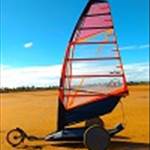
The reason for the larger size "Westward" is a windsurfer "cambered sail" (they have roller cams that clip onto the mast at the front of the bottom 4,5, or more battens in a larger luff pocket to make an aerofoil shape when tensioned up.). is down hauled and absolutely drum tight without any sheet rope tension at all. So big is better.

So when sailing and you get hit by a big gust of wind on a conventional soft sail you sheet out and loosen the fabrics tension. If it's bad enough it will belly out the sail, flap or resonate like hell and shake the mast, compromising the traction on particularly the front wheel. This is totally the
opposite of what you want to happen when you are in trouble.

When the cambered sail sheet rope is released it simply twists off/weathervanes (just the same as a soft sail), BUT doesn't belly out at all and the whole sail is still under enormous tension from it's down and outhaul and there is simply no way it can flap.
When your not using all the power of the sail, it's simply twisted off/weather vaned at the top from the apparent wind and causing very little drag. But when the power of the extra square meters of area is needed (up and down wind) or in lighter conditions, Sheet in and it's all there to be used.
In very light conditions with a limp sheet rope, the cambered sail is already set to the
perfect aerofoil, even before any breeze is detected and ready to power away with even the slightest gust. It just makes sense.
Most times it takes a lot of coaching to even get someone to get in and take our land yachts for a sail in such strong wind conditions, with so much "real estate" up the mast.
But the guys always return with a huge smile, totally amazed and convinced it's so easy to control. ("Touch wood", No one has ever tipped my yacht trying it out in these gusty conditions.)
Sure they will lift a wheel, but can be fully powered up and easily controlled on only 2 wheels and use this to slingshot forward when the gust eases.
If it all goes wrong, just dump the sheet rope at any speed and the sail will just weathervane and nothing else happens. You just slow down.
The boom will not move away from the foot of the sail, flap or try and kill you, as it sits under the sail due to the high out-haul tension and the aerofoil shape holds it in it's neutral position.
Hope I have managed to explain it properly.




 Particularly while trying to do it with a flexible lever.
 )
)