Hi Guys,
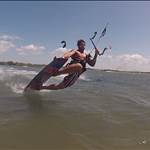
Back from holidays and thought I might be able to add a few thoughts. There are generally two types of big. There's big height, and big hangtime. Usually, these two types of jumps come from quite different kites.
Generally speaking, C-shaped kites and Delta shaped kites will take you to the highest jumps. They tend to be more violent in the ascent and "throw" you up high, but on the flip side, they tend to drop you pretty fast without really clever kite flying skills on the way down. The jump itself comes from the reverse direction pull of the kite, or if you like, the pendulum effect. Speed and a fast redirect will see you up high. Timing is EVERYTHING!
So if you are looking for hangtime, forget "C-shaped kites". Hangtime kites (higher aspect) or the current race kites tend to take you up far more smoothly, some will take you up to similar heights of C's and delta's, but you will remain at the apex longer and have a much more gentle and slow return to the aqua. The height tends to depend a lot on the size of the kite. The jump itself comes from a more efficient aerodynamic profile and a wider, higher aspect wing shape, or in different terms, a greater lift generating surface area. To jump a high aspect kite you redirect somewhat (limited by turning speed of the high aspect kites), but the performance of the wing and the apparent wind do all the lifting, this is partially why the jumps are much smoother, not a lot of pendulum, mostly pure lift. The disadvantage is they are slower to turn and harder to hold an edge when taking off, especially in rough water.
Toby will be riding his new 2015 18m "Airtime" Rebel this year. This kite was designed for him and is a "one off" (6 struts). This kite is designed for 20 knots and has the added struts for canopy stability and holding the profile when overpowered.
A few notes on "going big" before talking about kites. Firstly you need to be LIT! You'll never go big if you aren't really powered up (Being "lit" on a 20m kite in 15 knots won't do it). Secondly, you need control! If you can't hold an edge, you'll never go large because it's all about what you do in the one second before you lift off. You need a smaller kite and very strong wind. Oh, and you need lots of experience. Flat water really helps

Small kites redirect faster and can be flown in much stronger winds.
My recipe for a boosting kite is to take a kite with a very stable canopy like the Rebel. The stiff structure and taut canopy allow the kite to behave really well when you are overpowered by locking the profile solidly and not allowing any fluttering on the trailing edge, or tips or backwinding of the leading edge. I like a 9m kite in around 30-35 knots. Gusty wind is often best as you can see the gusts on the water and boost into them for a really fun secondary lift as the gust hits the kite. If you're kite is bucking and fluttering and shaking when you are only sheeted slightly for power and riding fast, it's not the right kite. The kite must be composed, in control and comfortable. There are very few kites that feel like this when really overpowered. The Core Riot XR3 is a similar kite. They are neither C, nor high aspect, nor delta. They sit nicely in the middle of these three designs and offer the best compromise of speed, control and lift. The Edge is good for lofty jumps, and they tend to be reasonably high and floaty, but lack the adrenaline kicking acceleration off the water.
Sorry for only speaking of kites we stock, but these are the kites I have experience with. The old 2003 Airush Lift Pro was pretty insane too .... back in the day

Anyways, hope this helps, if anyone wants more specific info on technique, design or other advice, feel free to ask here or via PM if you like.
DM