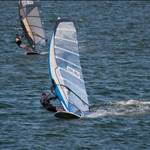
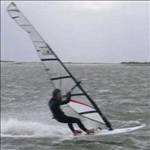
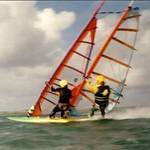
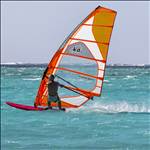
The leverage moment only depends on how far outboard the centre of gravity of the rider is. The harness and boom positions are internal forces which, unless they restrict how far outboard you can get your c of g only really affect comfort and control.
The leverage moment is of course balanced by the moment of the sail. You can hold onto a more powerful sail if the lift is centred lower down.
The width of the board is important because if you can sail with the board railed to leeward, the fulcrum shifts off axis. Thus you have more moment available to hold down sails. You need to select the correct size fin to be able to let the board rail to leeward comfortably. If the fin is too short you'll need very strong ankles to cope with the internal forces required to rail the board leeward.
Formula boards railed to leeward can get the sailors weight a long way from the fulcrum and can take large sails.
The effect is most pronounced and easier to see in a catamaran which is sailed on the leeward hull giving a sailor a lot of leverage to hold big sails.
Here's an idea I had a while ago on an asymmetric speed board which combines the width to carry a larger sail with the narrowness to not get bounced around too much in chop. Why stop at asymmetric fins?




 Lots of chicks weigh in at around 53 KG. I'd be happy to try windsurfing with one of them sitting on my shoulders strictly in the interests of science of course.