Waiting4wind said...So I got my gear and I'm am now in the test production phase. Probably will end up cheaper if I buy a new spolier but not as much fun. Also a good way to kill many non windy hours.

I have struck a small problem that Chris alluded to......
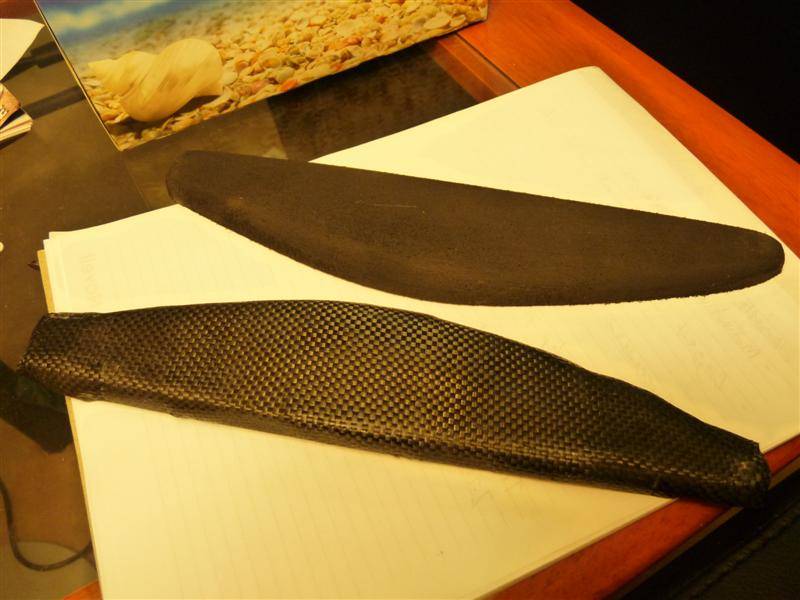
I made the blanks for the piece I need out of balsa wood because in the end it was easier to get and it isn't affected by surf board resin which I believe has less tendency to yellow.
The problem is that the carbon cloth is relatively stiff so it didn't like to go around corners well and stay down, I used some tape which sort off worked. Could i put a plastic bag over it and tension down (I suppose that's what vaccum baging is all about?).
The cloth was also too stiff to form around the end bits which taper down to the size of a thumb. The carbon cloth just gathered up. I was thinking I could cut away the excess and then rejoin it, but it would probably fray when cut?.
Chris ...Keef or any other experts...suggestions.
I'm definitely not an expert, but there are different types of carbon cloth. There is a 'twil', which is a different weave and lends itself to covering non-flat objects. The weave will fit around things with a tight radius much better than the normal cloth.
If you cut the carbon carefully with a sharp pair of scissors it doesn't fray (much) and will blend in easily. I think the sharp scissors are the secret.
One thing that I have done in the past is to lay up the first layer with a covering layer of glad-wrap or similar plastic and then tape it down tightly with masking tape. You end up with bits where the resin is sitting proud of the rest of the surface, but you then sand the whole lot down smooth, without going too far through to the carbon. I think Keef has suggested in the past using plastic cheese wrappers with lots of holes poked through to allow the excess resin to come through. I think for irregular surfaces, that type of plastic wont follow the curves too well.
A suggestion that you often see is that you use a layer or two of fibreglass over the carbon as sacrificial layers to let you sand them, leaving the carbon intact. The fibreglass goes clear when it gets wet out.
After the sanding back to a smooth shape, you can then paint on a layer of epoxy (or in your case polyester), and you should have what you want. When the last coat goes on the carbon, the carbon once again looks shiny.
I haven't asked the fibreglass shops yet about UV stable epoxy, but it must exist. Anyone know of any?




 dont take it personal des) or take them off the part and shape to whatever you like, then get some more 5min aroldite and brush on and let it cure, once cured sand and paint in the same auto spray as the car ,from auto pro,the whole job shouldn't take any more than 2 hrs a piece"painted", if i have lost you send me a pm