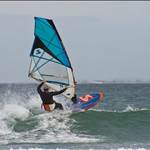
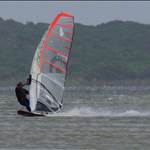
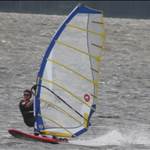
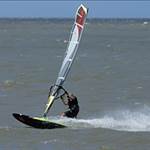
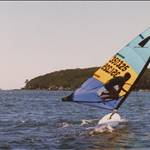
1) Your old gear has a lot of advantages as well as some disadvantages. It's tippier and slower in strong winds, but in light winds, an older longboard will be faster and better upwind than a modern wideboard, and can also go much faster with a small sail.
2) The biggest mistake I see beginners making is not leaning back (towards the wind, not the tail of the board) enough. Never lean forward and only have the mast tilted to leeward in very light winds.
3) Learn what the Centre of Lateral Resistance (on the board) is and what the Centre of Effort (in the rig) is. Learning how the board and rig react as the relationship of those two points change is the basis of windsurfing IMHO.
4) I see you're in Melbourne. They seem like a good bunch down there, but if anyone tells you that wideboards are always quicker and better, ask them if they did the North Sails Half Hour!

5) Lean back towards the wind!
6) Swap between your big and small sail in light winds - you can learn how to handle the power with one, and learn other techniques with the other. Don't be afraid to use the small sail for the early attempts.
7) Many people pull their back hand in too far, which stalls the sail out.
8) Don't pull the outhaul on too hard on those sails - at a guess, adjust it so the belly of the sail is 5cm from the boom unless it's windy. In strong stuff, use lots of downhaul and never have wrinkles running horizontally across from the luff - that's a sign that the downhaul is too loose. If it's windy and the board is always rounding up into the wind, move your hands back along the boom, lean back further towards the wind, and consider kicking the centreboard up 20 degrees.
9) With a longboard like the Tyronsea, you stand around the middle of the board unless it's really windy and you are planing downwind. Don't copy the shortboarders who stand well behind the mast - that's because they don't have centreboards.


 Wish I'd had someone show me how it was done when I was starting.

 Still trying to get back to how I was..or is that just rose coloured glasses..
 and wait around an hour for dinner!