Help me understand mast gates?

> 10 years ago
Reply
Register to post, see what you've read, and subscribe to topics.
DrRog
DrRog
NSW
608 posts
NSW, 608 posts
2 Nov 2013 10:42pm
G'day Breezers,

Forgive and correct me if I use the wrong terminology. So my mast has a bigarse feed slot as shown in the pic (note this is two photos side-by-side).
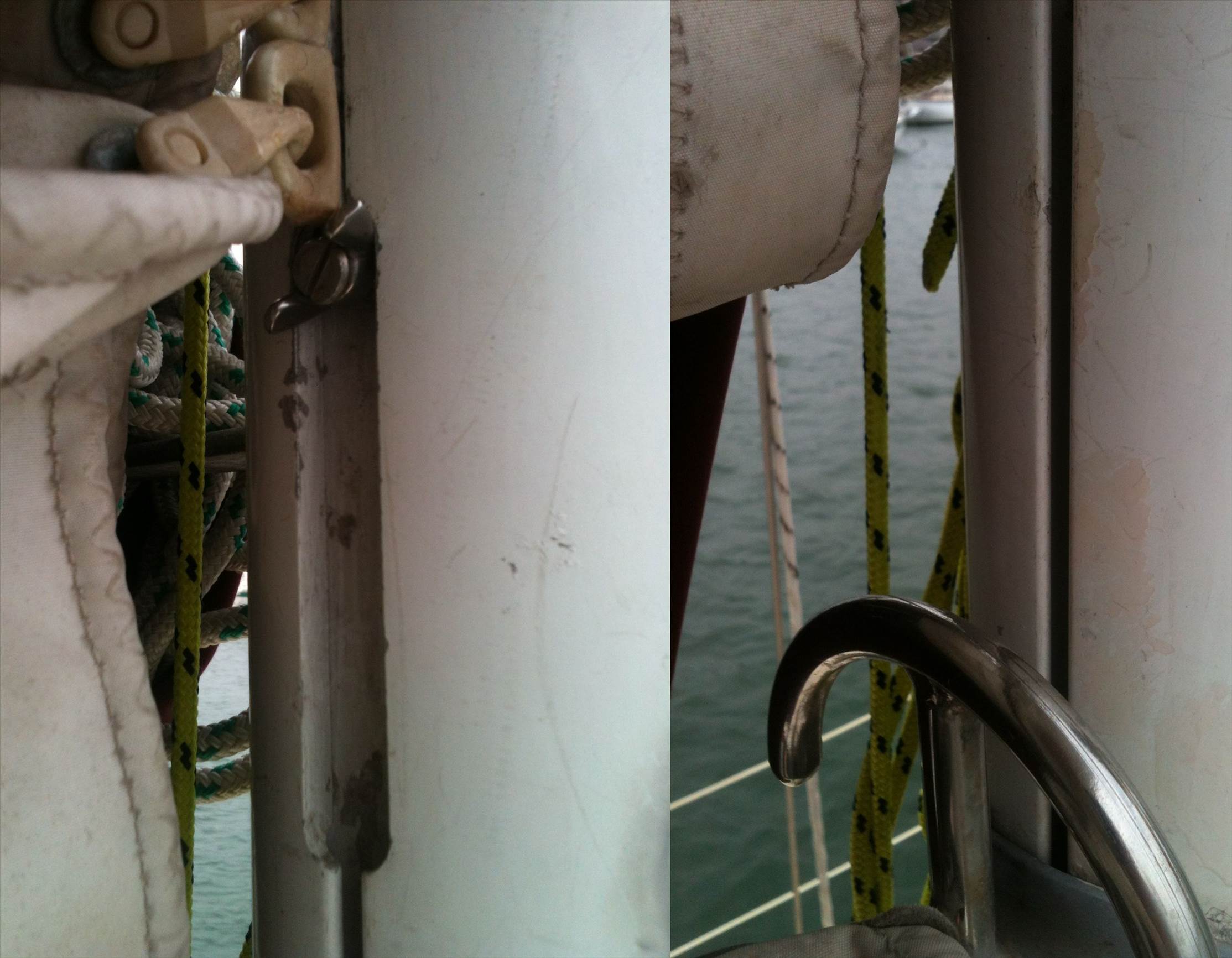

There is a makeshift sail track stop (which is just a long wing nut) at the top of the feed slot. Under full main the track stop stays in. This is all well and good but it means the flaked sail sits high above the boom (this is a problem because I plan on making a boom bag and I don't want excess windage) and it seems like it's more of a hassle to reef as I have to remove the track stop first.

So I discovered there are things called mast gates, as per www.myhanse.com/add-track-gate-insert-on-the-mast_topic7446.html

Ooohhhh, so it has just occured to me that there may originally have been a mast gate in this slot. Does anyone know? Does anyone have or used a gate similar to this?

Possibly I should be emailing my questions to www.mastgates.com but, you know, thought I'd ask here first - maybe someone can explain something more or save me some cash.

Cheers.

cisco
cisco
QLD
12365 posts
QLD, 12365 posts
2 Nov 2013 11:15pm
As you no doubt know, the gate is there to stop the sail falling out of the luff groove and when removed allows the sail to be changed, say for the storm trysail.

Yours does look to be somewhat high off the bailing hooks. This height was probably determined by the distance between the tack and the bottom sail slide. It is a good set up but as you have discovered, it is not ideal for fitting a boom bag.

Main sail operations are always carried out on the starboard side of the mast and head sail operations on the port side.

What you could do to facilitate the sail coming right down to the boom is to fill in the missing luff groove edges with stainless steel strips, bolted or riveted on the port side to be fixed, but on the starboard side pivoted from the top end and released at the bottom end by way of a large wing bolt so as to allow a gate.

The stainless strips don't have to be heavy as they will not be under any load. They will just contain the sail slide/s at a lower point when the sail is doused.

That is just my idea so see if somebody else comes up with better or more importantly SIMPLER.

You know the K.I.S.S. principle/rule. Keep It Simple Sailor.
cisco
cisco
QLD
12365 posts
QLD, 12365 posts
2 Nov 2013 11:29pm
Had a look at the link you posted and that is just a more expensive way of doing what your wing bolt does. It is not makeshift.

The gate in the link is good but to have one like that will require you getting a short (say 200 mm) length of the same mast extrusion as you have and cutting the luff groove part of it out to make a key piece.

Then you would have to cut away some of the metal of your mast where the gate is. I would be wary of doing that.
DrRog
DrRog
NSW
608 posts
NSW, 608 posts
3 Nov 2013 12:51am
Oh, I see what you're saying. Seems pretty simple. although will require strips of curved ss but if they don't need to take much load then they could be quite thin. Thanks Cisco. All other suggestions or insights appreciated.

By the way, my mast and boom winches and main halyard are to port. What behind this mast stb, foresail port thing?
Ramona
Ramona
NSW
7752 posts
NSW, 7752 posts
3 Nov 2013 7:44am
If you reef your main at the mast then while you are on STB tack you have right of way[mostly]. So you would be standing on the high side and have a good view forward. You have horns on the boom so looks like you have to go to the mast to reef.

That is an unusual system you have there with the slot for the slugs. Obviously because of the reefing horns the entry for the slugs is much higher. Normally the entry is just above the boom and the slugs retained by a pin. In your case a SS strip either side so the slides can go down the bottom would be fine but would have to be held in place by self tappers or pop rivets and removed each time the sail is taken off. Or an opening slot cut in the bottom. I would go the temporary ss strips held with self tappers or tapped threads and bolts.
mofo
mofo
QLD
91 posts
QLD, 91 posts
3 Nov 2013 7:15am
If it was me and you wanted to remain using the reeding horns, I would remove the wing nut and bolt , get a piece of garden hose the length of that feeder slot and wedge it in , if I wanted to
remove /reef the sail off the mast simply pull out the hose...

1x 10 cent piece of hose , cut half a dozen of them in case you drop one ob or tie a lanyard on it so you can't loose it.

The other option is to not use the horn and put a block and tackle with a hook which would be long enough to reach above the feeder slot and reefed flaked sail and hook through the reefing Cunningham point . That way the hose or wing nut stays in permanently , your sail looks too high for this though ? , . The wing nut is a bad idea having to remove that at sea cos I can see that going over the side.
MattM14
MattM14
NSW
190 posts
NSW, 190 posts
4 Nov 2013 10:14am
That slot does indeed seem very high off the boom. You can't even see the slot in the picture on the right that has the boom in frame so it is quite a way up the mast.

Reading your initial post I was thinking of something along the lines of Cisco's suggestion. Keeping in mind that your objective is to lower the flaked sail so it sits closer to the boom so you are able to fit a boom bag you could apply the s/s strips that Cisco suggests so that they cover the entire (existing) slot. Then cut a smaller (length) slot lower down closer to the boom so that you can still get the slugs out if you need to. You would still need a stop on this new slot and perhaps the hose suggestion is not too bad here (simple and cheap).

As Cisco points out the s/s strips will not be carrying any load when the sail is up because all your slugs would be sitting above this.
cisco
cisco
QLD
12365 posts
QLD, 12365 posts
4 Nov 2013 2:47pm
DrRog said..
By the way, my mast and boom winches and main halyard are to port. What behind this mast stb, foresail port thing?


Headsail halyards to port and mainsail halyards to starboard is a convention or protocol most people use and is generally accepted in the yachting fraternity a result of which is that when people crew on different yachts they don't have to relearn the whole sail handling system.

When you say your main halyard and winch are to port, I am thinking you may be using your boom topping lift (which usually doubles as a spare main halyard) as the main halyard and using your main halyard as a topping lift.

Have a click around here. Some of it is good.

www.google.com.au/#q=sailboat+running+rigging+diagram
DrRog
DrRog
NSW
608 posts
NSW, 608 posts
4 Nov 2013 6:23pm
Thanks all for your input. Currently in mountains, away from PC and boat, so will check this all out when I return.
HaveFun
HaveFun
NSW
201 posts
NSW, 201 posts
5 Nov 2013 4:53pm
Interesting principle Cisco (standardize on Headsail to port and mainsail to starboard). I will play closer attention to what people are actually doing down at the marina. I'll let you know the results of my random survey. certainly my boat has the headsail halyard is on the port side of the mast.
lloydyboy53
lloydyboy53
VIC
49 posts
VIC, 49 posts
10 Nov 2013 10:54am
G'day Dr Rog
Check out this link. It will reveal all you need to know about mastgates. I originally had the same set up as you. I made my own from a bit of aluminiun strip that you use to cover the carpet/lino join. I riveted one side and tapped the other side and put in a thumb screw so that sail changing is easy. Best thing ever. You can but them ready-made but I am a tight-arse.
Cheers
www.google.com.au/search?q=mastgates&rlz=1T4ADFA_enAU427AU429&tbm=isch&tbo=u&source=univ&sa=X&ei=Tbt-UticLai6iAe144HwCA&ved=0CEEQsAQ&biw=1138&bih=575
Please Register, or first...
Topics Subscribe Reply

Return To Classic site 😭
Or... let us know if a problem, so we can tweak! 😅